
The Breakdown
Here’s what I’m seeing from the consulting and advisory side of our work at Intreensic.
Five years ago, every fintech founder I spoke to needed developers who could build a clean mobile app. The conversations were about user interfaces, onboarding flows, and getting people to download something. That era is over.
The industry has moved into what I’ll call the infrastructure phase. We are no longer just building apps; we are building the invisible rails underneath them. Real-time settlement systems. Multi-party reconciliation engines. ISO 8583 parsing for card networks. Risk and AML transaction monitoring that runs in milliseconds. Compliance programmes that hold up under audit.
This kind of work demands a completely different talent profile. You don’t just need someone who can code; you need professionals who understand how a payment instruction moves from initiation to settlement — and what can go wrong at every stage. People who can interpret a specification standard correctly, design a viable fee structure, or build a KYC workflow that satisfies the regulator.
These talents barely exist on the continent at scale.
What just made this worse

On March 10, the Central Bank of Nigeria issued a directive that makes the talent gap an immediate operational crisis, not just a strategic concern.
The CBN now requires every bank, payment service provider, mobile money operator, and international money transfer operator in Nigeria to deploy automated AML monitoring systems. Deposit money banks have 18 months. Every other regulated financial institution has 24 months. And all of them must submit a detailed implementation roadmap within 90 days — which puts the first checkpoint around June 2026.
These aren’t optional upgrades. The systems must integrate customer identity data, risk profiling, sanctions screening, and real-time transaction monitoring. Institutions that want to use AI and machine learning for compliance — which is increasingly the expectation — must have those models independently tested every year for accuracy, bias, and performance drift.
Think about what this means in practical terms. Every regulated financial institution in Nigeria now needs professionals who can architect automated compliance systems, connect them to core banking infrastructure, and keep them running under regulatory scrutiny. That’s not a developer job. That’s not a traditional compliance officer job. It’s a hybrid role that barely existed five years ago — and every institution in the country is now competing for the same small pool of people who can do it.
The wider picture
The World Economic Forum reports that two-thirds of financial organisations globally cite skills shortages as their primary obstacle to transformation. In Africa, where the fintech opportunity is arguably the largest in the world, that gap is magnified.

Meanwhile, the senior talent that does exist has been actively recruited offshore. Companies in Canada, London, Dubai, and Singapore are hiring African payments professionals faster than local institutions can develop them.
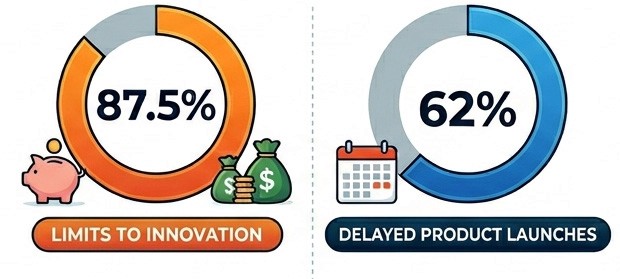
And the pressure is only increasing. A CBN fintech industry report found that 87.5% of Nigerian fintech companies say the cost of meeting regulatory and risk requirements already limits their ability to innovate. Over 62% say regulatory timelines affect how quickly they can launch new products. Now layer this new AML automation mandate on top of that existing burden.
There’s also a cross-border dimension. The CBN is exploring regional passporting frameworks that would let Nigerian fintechs expand into markets like Ghana, Kenya, and South Africa through mutual licence recognition. But stronger financial crime controls are going to be a prerequisite for those arrangements. Companies that can’t demonstrate automated, auditable AML infrastructure won’t qualify.
So, we’re in a bind: the infrastructure is becoming more complex, the regulatory environment is getting more demanding on a specific timeline, and the talent pipeline is increasingly thinner.
This isn’t a problem that more funding solves. You can raise $50 million, but if you can’t find 20 people who genuinely understand payment system architecture, compliance automation, and settlement operations — your roadmap is just fiction.
What this means if you’re building a career in digital banking:
The professionals who invest in deep, infrastructure-level payments knowledge right now will own the next decade. Not the generalists. Not the people chasing titles. The ones who understand the plumbing — and can prove they can keep it compliant.
The Opportunity
The single most in-demand role I’m seeing across our consulting and resourcing work right now: Payments Compliance Specialists — professionals who understand both the technical and regulatory sides of payments infrastructure.
Banks and fintechs across West Africa were already struggling to fill these roles. The CBN’s new directive has turned that struggle into a crisis with a deadline.
Here’s the specific demand I’m tracking:
If you’re considering a career pivot into digital banking, compliance is where supply is lowest, and demand is climbing fastest — and the CBN just put a regulatory clock on it.
The Resource
We built a Payments Career Roadmap that maps out the key roles, required skills, and real career paths in Africa’s digital banking and fintech sector — including the compliance, architecture, and operations roles I described above.